
If your shower goes cold halfway through and your water bill has crept up two years running, the pipes inside your walls are almost certainly the reason. Most LA homes built before the mid-1990s are still running on the original galvanized steel or thin-wall Type M copper, and both of those materials fail in predictable, expensive ways.
Homeowners in Los Feliz, Mar Vista, Eagle Rock, and across the South Bay tend to call us with the same two complaints, in roughly that order: the hot water doesn’t last, and the LADWP bill keeps climbing even though nobody added a teenager or a hot tub. The pipes are the connective tissue between those two problems, and once you understand what’s happening inside them you can stop throwing money at symptoms (low-flow showerheads, water-heater flushes, leak detection patches) and address the actual cause.
This piece walks through the specific failure modes we see in LA housing, the math on how those failures show up on your bill, what a properly executed repipe changes, and the questions to ask any contractor before signing a contract. I’ve been installing Type L copper and PEX systems in Southern California for more than three decades, so the examples here are pulled from actual jobs in actual neighborhoods, not from a Wikipedia summary.
| QUICK ANSWER
Hot-water shortfall and rising bills in older LA homes usually trace back to one of three pipe problems: galvanized steel choked with rust scale, Type M copper developing pinhole leaks from acidic or hard water, or polybutylene that’s overdue for full replacement. A whole-home repipe in Type L copper or PEX-B with cold-expansion fittings restores flow, ends the slow leaks, and typically returns water-heater performance to what the manufacturer rated. |
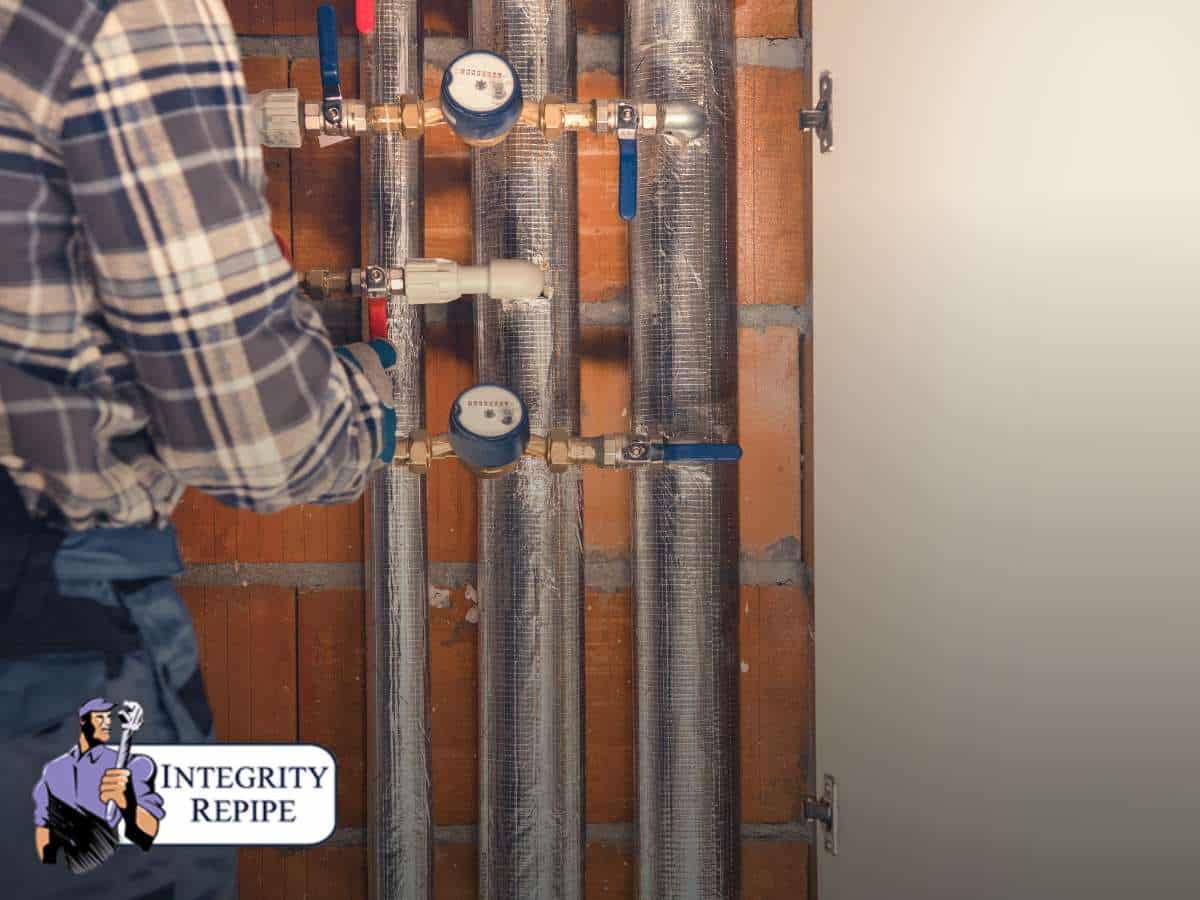
The two things actually driving your bill (and they’re both inside the walls)
Two failure modes do most of the damage in LA-area plumbing, and they don’t look the same. One is a flow problem. The other is a leak problem. They often happen in the same house at the same time, which is why “just replace the water heater” rarely fixes anything for long.
Mineral scale and rust narrow your pipes
LADWP-supplied water in Los Angeles County tests in the moderately-hard-to-hard range. According to LADWP’s water quality FAQ, hardness varies meaningfully by service zone, and most neighborhoods sit comfortably above the threshold where calcium carbonate starts depositing on pipe walls. Inside a galvanized steel pipe, that mineral layer combines with rust from the inside of the pipe itself. Over thirty years, a 3/4-inch galvanized line can constrict to the effective inside diameter of a drinking straw.
You feel it as low hot-water pressure upstairs, a kitchen sink that takes forty seconds to deliver hot water that used to take fifteen, and a shower that runs cold the moment the dishwasher kicks on. You don’t see it on the bill directly, but you see it indirectly: the water heater runs longer to push hot water through a restricted line, and the household runs more total water trying to compensate.
Slow leaks you can’t hear are still on the meter
Type M copper installed in LA tract homes from the late 1970s through the early 1990s has a known pinhole-leak issue, especially when paired with the more aggressive water chemistry that came online when MWD’s blend shifted. A pinhole leak under a slab can lose 50 to 60 gallons a day before anyone notices a damp spot. That’s the equivalent of running an extra shower per day, every day, billed at the LADWP tiered rate.
The EPA WaterSense fix-a-leak guide puts household leaks at nearly 10,000 gallons of wasted water per year on average, and the worst 10% of homes lose 90 gallons or more per day. In Southern California, leaks in pre-2000 copper are a large share of that.
Here’s what one of those decisions looks like from the homeowner side, in a 26-year-old home in our service area:
| “We experienced a leak and after our local plumber came to see the issue we determined there were too many additional issues with our 26 year old copper pipes and that we should replace with PEX, he also recommended Integrity Repipe and I’m sure glad he did. They came by the same day I called with a quote and a very fair price when comparing to others I know having their system replaced.”
Posted by Dan Walsh, 5-star Google review (February 2026). |
What’s under your floor: matching the pipe to the LA housing era
Before any contractor talks costs, they need to know what’s in your walls. A walk-through estimate is worth less than the time it takes to crawl your attic and look at fittings at the water heater. Material identification is straightforward once you know what to look for, and the era of the house tells you most of what you need to know.
Galvanized steel (homes built roughly 1930 to 1960)
Magnetic, dull gray, threaded fittings at every joint. If your house predates the freeway you’re driving on, expect galvanized. By the late 1980s the interior cross-section is half what the spec called for; by year fifty, it’s a candidate for full replacement and not much else. Patching a galvanized system makes the next failure worse, not better, because the new fitting becomes a galvanic-corrosion site.
Type M copper (homes built roughly 1970 to 1995)
Copper-colored, soldered sweat fittings, thinner wall than the Type L spec. Type M was the residential default for decades in California, and it works fine until the water chemistry changes or a recirc pump runs the same water past the same elbow ten thousand times. The Copper Development Association publishes tube-wall specs that explain why Type L is the upgrade most repipers reach for: roughly 50% thicker wall than Type M on a 3/4-inch line.
Polybutylene (homes built roughly 1978 to 1995)
Gray, plastic, often with copper or brass fittings. If you have polybutylene, replacement isn’t a question of bill optimization, it’s a question of when the next failure happens. The Cox v. Shell class settlement closed in 2009, so any payout window is long shut. Failure rates on installed polybutylene rise sharply after twenty years in service, and California carriers increasingly require replacement before binding new homeowner policies.
Pre-2010 PEX-A with brass fittings
Some early PEX-A installs used brass fittings that have shown dezincification issues in hard water. These can pinhole at the fitting, not the pipe. If your house was repiped between 2002 and 2010 and you’re getting drip leaks at hidden junctions, this is a candidate. The fix is usually a partial repipe at known failure points, not a full rebuild.
Why a one-day repipe pays for itself faster than people expect
The repipe payback math doesn’t come from the headline water savings alone. It comes from four stacked items, and the LA-specific version of that math is different from what you’ll see on a national plumber’s blog. Here’s how it actually breaks down.
First, the leaks stop. If your pre-repipe baseline was 50 to 80 gallons per day of unseen leak loss, that’s 18,000 to 29,000 gallons a year off the meter. On LADWP’s tier-2 residential rate, that’s a real number, not a marketing one.
Second, water-heater efficiency returns to spec. Water heating is roughly 12% of total home energy use according to ENERGY STAR. When the heater is fighting a restricted supply line and short-cycling because the hot side can’t recover, you can lose meaningful percentage points off its rated UEF before the unit itself is the problem.
Third, the household stops compensating. Five-minute showers don’t turn into nine-minute showers when the hot water arrives in fifteen seconds instead of sixty. The dishwasher and washing machine don’t double-cycle because the inlet temperature finally hits the rated setpoint.
Fourth, the wall and slab repairs from the next leak event don’t happen. A single significant slab leak in a Mid-Wilshire condo, including hardwood, drywall, and mold remediation, will routinely clear the cost of the repipe by itself.
| “When a homeowner tells me their bill went up forty dollars a month over two years and the water heater is only six years old, I already know what’s in the walls before I open the access panel. Galvanized doesn’t fail all at once. It fails one fitting, one elbow, one drop-line at a time, and the bill is the first place you see it.”
Joe Ludlow, Master Repiper, Integrity Repipe |
Copper or PEX: the answer is mostly about the slab
If your existing system runs in the slab and your home is on a concrete pad rather than a raised foundation, PEX-B with cold-expansion fittings re-routed through the attic is usually the better answer. If you’re a raised-foundation home and access is straightforward, Type L copper still wins on lifespan in our experience. There are edge cases (recirc loops, multi-story, custom builds) where the calculus shifts. A good estimator looks at the house, not a spec sheet.
What an LA whole-home repipe actually looks like
The work breaks into three days for most single-family homes, and one long day for smaller condos and townhomes. Inspection by the local building department closes out the permit. Drywall patch and stucco repair finish the cosmetics. Most LA-area cities require a permit pulled by a C-36 licensed plumbing contractor, and the California Contractors State License Board (CSLB) license search is the cleanest place to verify any contractor before you sign. Integrity Repipe holds C-36 license #993925.
Day one: rough-in
Two crews show up early. The plumbing crew opens limited access points (typically attic, behind the water heater, at each fixture wall), runs the new line, ties in the fixtures, pressure-tests the system, and hands it off to the city inspector. The drywall crew protects floors and prepares the patch zones. Water is off for most of the day; planning a meal out helps.
Day two: inspection and patch
City inspector signs off on the rough-in (each LA-area jurisdiction has its own building department: City of Los Angeles LADBS, City of Long Beach Development Services, City of Glendale Building & Safety, and so on). Drywall patches go in. The plumbing crew restores fixtures and tests under household pressure.
Day three: texture, paint-ready
Texture matched to existing wall surface. The patches are paint-ready. We don’t paint (color matching across an entire home is a separate trade), but the wall is ready for a painter the following week. If you’re mid-renovation, this is the right time to repaint anyway.
Here’s what the three-day version looks like in practice, in a homeowner’s own words:
| “Amazing! Just amazing! Price incredibly good. First day: seven workers show up at 8 AM and done by 3 PM with the re-pipe. One worker dedicated to just keeping everything clean. Everyone wearing masks and not taking them off during covid. The next day: 6 workers show up to cover holes interior and exterior walls. Beautiful work! I think my walls in the bathroom are better than before the re pipe.”
Posted by Paul Hoffman, 5-star Google review (July 2020). |
Five questions to ask any LA repiper before you sign
Most of these are deal-breakers if the answer is wrong. None of them are advanced. Ask them on the estimate call, listen to how the contractor answers, and you’ll know within ten minutes whether you’re talking to a specialist or to a general plumber who repipes occasionally.
- What’s your CSLB license number, and can I verify the C-36 classification?
- How many whole-home repipes did your crew complete last year?
- If we go PEX, which brand and which fitting type (cold-expansion vs. crimp)?
- Who pulls the permit and who meets the inspector?
- What does the lifetime warranty cover, exactly, and is it transferable?
If the answer to question 5 is vague, ask for a sample of the actual written warranty document before signing anything. Our lifetime guarantee is written, transferable to the next owner, and we publish it before quoting. References from past LA-area jobs are available on the references page.
Bottom line
If you’re running out of hot water and your bill is climbing, the pipes are almost always the cause, and patching individual failures gets more expensive as the system ages. A whole-home repipe in Type L copper or PEX-B, done by a C-36 contractor that specializes in repipes (not a general plumber moonlighting), is the move that actually fixes the problem rather than postponing it.
Integrity Repipe serves Los Angeles County, Orange County, and the San Diego service corridor from our San Clemente office. We’ll send an estimator to your home, identify the existing pipe material, walk you through copper vs. PEX for your specific layout, and put a written number in front of you the same week. The estimate is free.
Call 949-397-2404 or request a free in-home estimate. See the Master Repiper page for credentials, or review our PEX repipe and copper vs. PEX-B service pages for material specifics.
CSLB license #C-36-993925, verifiable at cslb.ca.gov.
Frequently asked questions
How do I know whether my hot-water problem is the heater or the pipes?
Run the hot tap at the fixture closest to the water heater. If it delivers full pressure and stays hot for twenty minutes, the heater is fine. If pressure drops or the water turns lukewarm before the tank should empty, the supply lines are restricted. A second tell: if hot pressure is fine at one fixture but bad at another, it’s almost always pipe restriction, not the heater. Our slab leak diagnostics page walks through related symptom patterns.
How much does a whole-home repipe cost in LA?
Most single-family LA-area repipes land between $4,000 and $9,000 for PEX-B and $7,000 to $14,000 for Type L copper, depending on square footage, story count, and access. Custom homes, multi-story, and recirc-loop installs push higher. Get three written estimates from C-36 repipe specialists, not from general plumbers; the variance between a specialist and a generalist on this work is usually larger than the variance between specialists.
Will a repipe lower my water bill enough to pay for itself?
Payback math depends on what your pipes are doing now. If you have an undiagnosed slab leak losing 50 to 80 gallons a day, the water-side payback alone is roughly three to seven years on LADWP rates. Add water-heater efficiency recovery, avoided emergency-leak repairs, and avoided drywall damage, and the practical payback for most LA homes with pre-1995 plumbing is under five years. For homes with no current leaks, the case is more about resale, insurance, and avoided future damage than about month-over-month bill reduction.
Do I need permits, and who pulls them?
Yes. Every LA-area jurisdiction we work in requires a plumbing permit for a whole-home repipe. The contractor pulls the permit, schedules inspection, and meets the inspector on site. If a contractor offers to do the work without a permit, that’s a deal-breaker; unpermitted plumbing work creates resale disclosure issues and can void homeowner insurance on a future leak claim. Verify your contractor’s C-36 classification before the work starts (the CSLB license-search tool is the right place to do it).
Should I pick copper or PEX for my LA home?
PEX-B is the right answer for most slab-foundation homes built after 1970, because the install runs through the attic and avoids re-cutting the slab. Type L copper is the right answer for raised-foundation homes, custom builds, and homeowners who prioritize lifespan over install simplicity. There’s no universal winner; the layout of your house decides. Our copper vs. PEX-B comparison goes deeper on the technical tradeoffs.
Does a repipe affect my homeowner’s insurance premium?
Some California carriers offer a discount for verified whole-home repipes (especially polybutylene replacement); others don’t price it in directly but use it underwritten as reduced risk. Call your carrier with the new pipe material and install date once the permit closes; the documented repipe is a useful artifact when you renew. We provide the permit close-out paperwork and a copy of the lifetime warranty for your records.
How long will the water be off?
Most single-family jobs run water off from roughly 8 AM to 5 PM on day one of the rough-in. Day two (drywall patch) and day three (texture) don’t require water shutoff. We coordinate the schedule so the household has at least one fixture working overnight whenever practical. For multi-unit buildings or larger homes, the off-window can extend into a second day; the estimator scopes this on the walk-through.
What’s the difference between Type M and Type L copper?
Wall thickness. Type L is roughly 50% thicker than Type M on a 3/4-inch line, which extends service life under aggressive water chemistry and high recirc-pump flow. Type M was the residential default for decades and works fine until it doesn’t; Type L is the upgrade most LA repipe specialists default to in a rebuild. Both types meet ASTM B88 code for residential potable water, but the failure curves diverge as the system ages, especially in homes with recirculating hot-water loops where the same water moves past the same elbows continuously.
Can you repipe a home with HOA approval requirements?
Yes. Most LA-area HOAs (especially in Mid-Wilshire, Westwood, and Marina del Rey condo complexes) require notice, sometimes board approval, and proof of insurance from the contractor. We handle the documentation packet for HOA submission. The lead time to HOA approval is usually two to four weeks, so plan accordingly if you’re trying to fix a leak the HOA already knows about.
How do you protect my home during the work?
Floors get covered with rosin paper and runner protection. Furniture stays in place where possible and gets draped with plastic where it doesn’t. Access cuts are made small (usually 6” by 6” where possible) and reused for the patch. One crew member is dedicated to cleanup throughout the day; we don’t leave drywall dust in the carpet at the end. Customer reviews on the references page and on our testimonials page consistently flag protection-and-cleanup as a differentiator.
Is the lifetime guarantee transferable if I sell the house?
Yes. The Integrity Repipe lifetime warranty transfers to the next homeowner with no fee and no re-inspection requirement, which is a useful resale artifact. The full warranty terms are published on the lifetime guarantee page; we provide a printed copy at job close-out so you can keep it with the title paperwork.
What if I only have a small leak and don’t want a full repipe?
If your system is under fifteen years old and the leak is at a single identifiable fitting, a spot repair is reasonable. If your system is over twenty-five years old, every spot repair becomes the start point for the next failure (especially in galvanized, where new fittings create galvanic-corrosion sites). The honest answer depends on the system age and what we find on the walk-through; a good estimator will tell you when a spot repair is the right call rather than upselling you to a full repipe.