
By Joe Ludlow, Master Repiper, Integrity Repipe Inc.
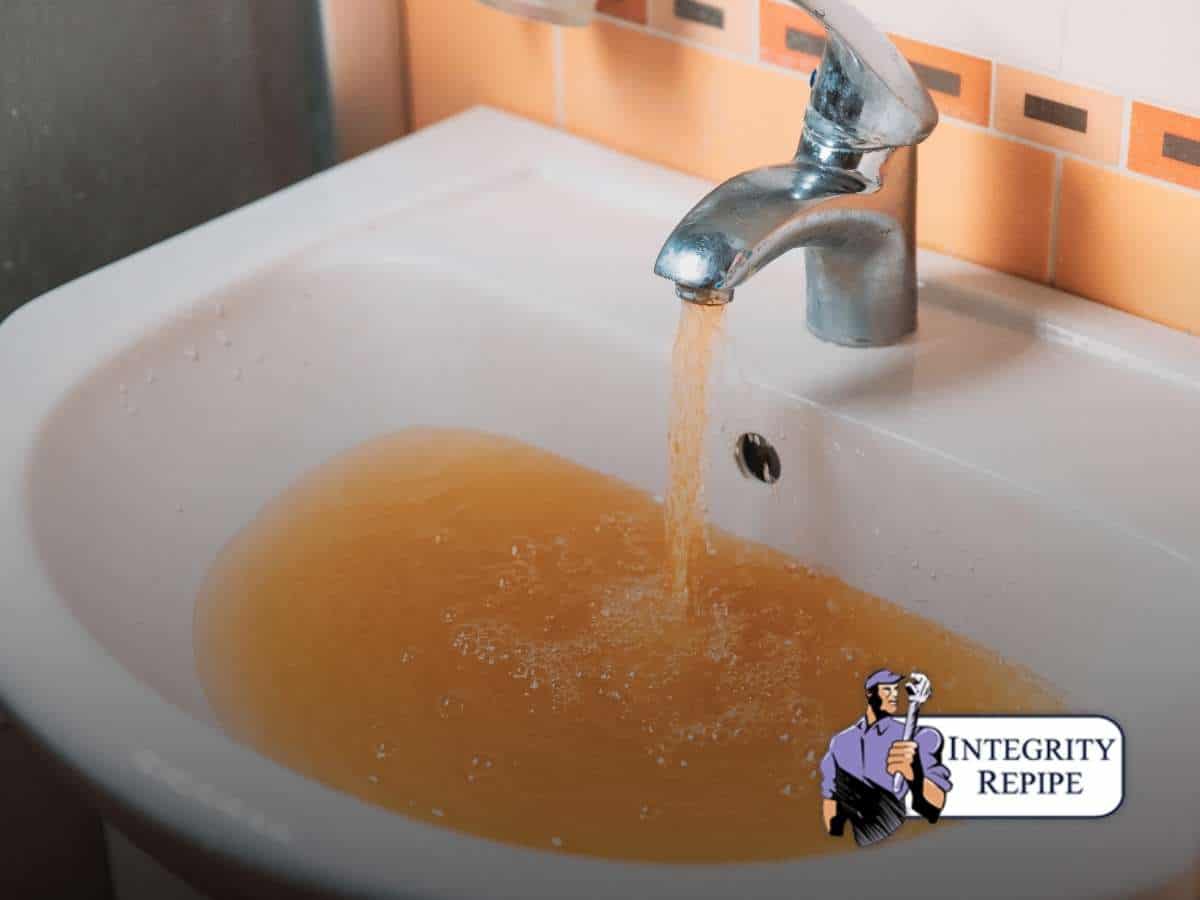
You turned on the tap and the water came out orange. Before you call anybody, there are three checks you can run yourself, and they take about ten minutes.
Those ten minutes are worth it because rusty water has three completely different causes, and two of them have nothing to do with your plumbing. One is a problem your water district fixes. One is a problem a water heater technician fixes. Only the third is a piping problem, and that’s the one worth moving on quickly. Telling them apart is easier than most homeowners expect, and it doesn’t require any tools.
Here’s how to sort it out, and what each answer actually means for your house.
Start With The Ten Minute Test, Not The Phone
Three questions separate the three causes. Run them in order, because the answer to each one changes what the next one can mean.
Question one: does the cold water run discolored at the outside hose bib?
Go to the hose bib closest to where the water line enters your property, usually on the front or street side of the house. That fixture sits ahead of most of your interior piping, so it’s the closest thing you have to a sample of what the city is delivering. Let it run for two or three minutes into a white bucket or a light colored container. Color is almost impossible to judge in a stainless sink.
If that water is orange or brown, the discoloration is arriving at your property rather than being created inside it. That single result rules out most of the expensive possibilities.
Question two: hot side, cold side, or both?
Fill a clear glass from the cold side of a bathroom sink. Fill a second glass from the hot side, after letting it run long enough to actually get hot. Set them side by side against something white.
Hot only is the most common result we see, and it points at the water heater almost every time.
Question three: one fixture or the whole house?
Check at least three fixtures on different sides of the house, and include one you rarely use. A guest bathroom that sits unused for weeks will show sediment a daily-use kitchen faucet never does. That’s useful information, not a false alarm, because stagnant water is harder on pipe than moving water.
Now match your answers against this:
| What you saw | Most likely cause | Who to call first |
|---|---|---|
| Hot and cold both discolored, including the outside hose bib | Main work, hydrant flushing, or a pressure event on the street | Your water district |
| Hot side only | Water heater sediment or a used up anode rod | Water heater service |
| One or two fixtures, cold side, recurring | Corroding supply piping inside the walls | A repipe contractor |
If your result lands in the third row, keep reading. That’s the one with a clock on it.
“We experienced a leak and after our local plumber came to see the issue we determined there were too many additional issues with our 26 year old copper pipes and that we should replace with PEX… They came by the same day I called with a quote and a very fair price. The Repipe work was done the following Wednesday. The inspection was done on Thursday and all the drywall was done on Friday.”
Dan Walsh, San Clemente. Verified Google review.
If Hot And Cold Are Both Rusty, The Problem Probably Is Not Your House
Municipal water mains carry iron scale on their inside walls the same way household pipes do. Most of the time it sits there undisturbed. When a crew works on a main, when a hydrant gets flushed, or when a pressure surge moves through the system, that scale lifts off and travels downstream. It reaches whichever houses are below the disturbance, which is why a neighbor two streets over can have perfectly clear water while yours looks like weak tea.
Call your water district on the non-emergency line and ask one specific question: has there been main work, a hydrant flush, or a reported break in this area in the last 24 to 48 hours? They usually know, and they can tell you roughly how long it should take to clear. That call is free and it’ll save you a service fee.
While you wait, three things help and one thing hurts:
- Run one cold tap, ideally a bathtub spout, for fifteen to twenty minutes. Tub spouts move more water than sink faucets and have no aerator to clog.
- Leave the hot water alone. Every gallon of hot water you use pulls sediment into your water heater tank, where it settles and stays.
- Skip the laundry. Iron staining sets into wet fabric quickly and standard detergent won’t lift it afterward.
If you want to know what’s normally in your water, every California water system has to publish an annual water quality report, sometimes called a Consumer Confidence Report, by July 1 each year. The State Water Resources Control Board maintains the program and your district posts its own report. Look at the iron and manganese rows. If your system reports iron close to the limit under normal conditions, occasional discoloration after a pressure event is going to be a fact of life on your street rather than a one-time event.
If Only The Hot Side Is Rusty, Your Water Heater Is Talking To You
A standard tank water heater is a steel tank with a glass lining, and that lining is never perfect. To protect the bare spots, the manufacturer hangs a sacrificial anode rod inside the tank, usually magnesium or aluminum. The rod corrodes so the tank does not have to. It works well right up until the rod is used up, and then the tank starts corroding on its own schedule.
What a spent anode rod looks like from your faucet
You’ll see it in the hot water first, and it is usually worst in the morning after the tank has sat overnight. It often clears somewhat as the tank turns over during the day. That morning-worst, afternoon-better pattern is a strong tell, and it’s one of the few symptoms in plumbing that reliably points at a single component.
Flushing helps a young tank and buys almost nothing on an old one
Draining and flushing a tank clears loose sediment off the bottom. On a tank under about eight years old, that’s often the entire fix, and doing it once a year is good practice, twice a year if you’re on hard water. On a tank past ten or twelve years that is producing rust, flushing is a delay rather than a repair. The iron is coming off the tank wall at that point, and you can’t flush a tank wall.
One caution people learn the expensive way: flushing an old, heavily scaled tank can dislodge material sitting against a thin spot and turn a slow problem into an active leak on your garage floor. If the tank is already old enough that you’ve thought about replacing it, put the money toward the replacement. Our guide to water heater leaks and the fixes that actually work covers what to check before you decide.
If It Is One Or Two Fixtures, You Are Looking At A Corroded Supply Line
Galvanized steel pipe is steel with a zinc coating. The zinc is the protection, and in Southern California water it generally holds up for a few decades. Once it is gone, the steel underneath is in contact with water full time and does what steel does. It rusts from the inside out, building a rough layer of scale that narrows the pipe and sheds particles into whatever runs through it.
That’s why the symptom tends to show up at one or two fixtures before it shows up everywhere. Corrosion is never uniform. A horizontal run that holds water and sediment goes faster than a vertical riser. A branch feeding a bathroom nobody uses goes faster than the line to the kitchen sink.
What the twenty minute flush actually tells you
Running the affected fixture for twenty minutes is worth doing, but not for the reason most articles give. It’s not a fix. It’s a test, and the result arrives over the following two days:
- Clears and stays clear for weeks. Something disturbed the line once. There’s nothing to chase.
- Clears, then returns within a day or two. The pipe is shedding continuously, and it will keep doing that.
- Never fully clears. The interior of that line is far enough along that flushing can’t outrun it.
The second and third results are the ones that matter. A pipe shedding scale into your water is a pipe losing wall thickness, and wall thickness is the only thing standing between you and a leak inside a wall. If this is happening in a house old enough to have galvanized supply lines, read our breakdown of galvanized pipe corrosion and the repair options next, along with the four signs galvanized pipe has reached the end of its life.
A note on build era in South Orange County
Rough guidance rather than a rule: tract housing here built before the mid 1960s commonly went in with galvanized supply lines. Homes from the late 1960s through the 1990s are usually copper. Anything newer could be copper or PEX. Build era gives you a working hypothesis, but additions, remodels, and partial repairs mean plenty of houses carry a mix of materials, and the only way to be certain is to look at the pipe. Older houses deserve a closer read for exactly this reason, which is why we wrote about what makes repiping a vintage house different.
Rust Does Not Come From Copper Or PEX
Rust is iron oxide. It needs iron. Copper has none, and neither does PEX. Copper corrosion shows up as blue green staining around fittings and in tubs, not as orange water. So in a copper or PEX house, discolored water points at the heater, a leftover galvanized nipple or stub-out from a partial repair, or the street. That narrows the search considerably. Our copper versus PEX-B comparison covers how the two materials actually age.
What The Color Is Really Telling You
Here is the part most articles skip. Discolored water is not a water quality event that happens to be occurring inside a pipe. It’s corrosion product. Those particles in your glass used to be part of the pipe wall, and they’re only in the water because they’re no longer in the pipe.
That reframes the urgency completely. Rusty water isn’t a nuisance you tolerate until it gets worse. It is an early symptom of a process whose later symptoms are a pinhole leak behind drywall, a soaked baseboard you find by smell, or a slab leak you find on your water bill. By the time water is visibly colored, that process has been running a while.
“By the time the water turns orange, that pipe has been losing wall thickness for years. The color is not the problem. The color is the receipt.”
Joe Ludlow. Master Repiper and owner, Integrity Repipe Inc.
It’s also why we tell homeowners to take discoloration more seriously than low pressure. Low pressure is annoying, so it gets attention. Discoloration gets rationalized as the water district acting up again, and it’s usually the earlier signal of the two. If the color has shown up alongside an unexplained increase in your water bill, it is worth learning how to find hidden water leaks in your home before something opens up on its own schedule.
“Re-piping is no joke: 50 to 60 holes in drywall and stucco, lots of dust everywhere, a number of corroded copper pipes pulled out of the walls to make space for the new PEX. The water was off from about 9am until 4:30pm. After the crew turned on the water to check their work, they caulked all the new fixtures.”
Brian Toy, San Clemente. Verified Google review.
Is It Safe To Drink, Shower In, Or Wash Clothes In?
California sets a consumer acceptance level for iron at 0.3 milligrams per liter and for manganese at 0.05 milligrams per liter under Title 22 secondary drinking water standards. Those thresholds exist because of color, taste, and staining rather than because of a health limit, and the federal secondary standards published by the EPA use the same two numbers for the same reason. Water above them looks bad and tastes metallic. That’s what the standard is measuring.
So the short answer on drinking it is that iron at typical household concentrations won’t hurt you. The longer answer is that “not a health hazard” and “fine” aren’t the same sentence. Manganese is regulated as a nuisance at 0.05 mg/L but carries a separate federal health advisory at higher concentrations, with specific caution around infants. And when the rust is coming from your own piping rather than from the street, you don’t actually know what else is coming off that pipe wall alongside the iron, particularly in older systems with lead-bearing solder or brass fittings at the joints.
Practical answers to the three things people ask about:
- Showering and bathing. Fine. Iron does not absorb through skin in any meaningful amount. It will stain a light colored tub over time.
- Laundry. Don’t. Iron sets into wet fabric and ordinary detergent won’t lift it. If you’ve already run a load, keep it wet and treat it with a rust remover rather than putting it in the dryer.
- Drinking and cooking. Use bottled or filtered water until you know the source. If discoloration is recurring on your street, filtration options for your home tap water are worth a look. We have also written about why Southern California tap water is generally safe to drink when the plumbing carrying it is sound.
When A Repipe Is The Right Answer, And When It Honestly Is Not
We only do repipes. That’s worth saying out loud, because it means we have an obvious incentive to tell every caller they need one. We’d rather be useful than busy, so here’s the honest split.
These are not repipe problems
A single episode of discoloration at every fixture that clears within a day and doesn’t return is a street event, and there’s nothing in your house to fix. A hot-side-only problem in a house piped with copper or PEX is a water heater, and replacing the heater ends it. Sediment caught in one faucet aerator after a main flush is a five minute job with a wrench and a cup of vinegar. None of that needs a contractor with a drywall crew.
These usually are
Recurring discoloration on the cold side at more than one fixture, in a house with galvanized supply lines, is a repipe conversation. So is discoloration paired with any of the following: a previous pinhole leak, visibly reduced flow at multiple fixtures, or a slab leak history. Once corrosion is far enough along to color the water, spot repairs tend to become a pattern of spot repairs, because the rest of the system is the same age and the same material and it’s sitting in the same water.
How much of the house needs work is a separate question from whether to do anything at all. Some houses need everything. Some need one section, usually where an earlier partial repair or an addition left a stretch of original pipe behind a wall. We wrote up how to decide between a partial repipe and a full repipe because it’s the question homeowners ask most often after the first estimate, and the answer isn’t automatically “all of it.”
If it does come to replacement, the material choice matters more than most people expect going in. Our materials page covers what we install and why, and our write-up on Uponor PEX-A fitting failures explains why we standardized on Zurn PEX-B with expansion fittings instead of following the industry default.
Questions Homeowners Ask About Rusty Water
Why did my water turn rusty all of a sudden?
Sudden discoloration at every fixture almost always traces to something outside your house: a main break, hydrant flushing, or a pressure change that lifted iron scale off the inside of a municipal line. Sudden discoloration at one or two fixtures is more often a disturbance inside your own piping, like a shutoff valve being closed and reopened, or water hammer from a washing machine or an irrigation valve. Start with the ten minute test above. If the outdoor hose bib on the street side of the house runs discolored too, the source is upstream of your property line and your water district is the right first call.
Is rusty tap water dangerous to drink?
Iron in tap water is regulated as an aesthetic issue rather than a health one, at 0.3 mg/L under both California and federal secondary standards. At typical household concentrations it won’t hurt you. That said, when the iron is coming from your own corroding pipes, the sensible move is bottled or filtered water until you know which pipe is producing it, because a pipe interior in that condition can release more than iron. Homes with original galvanized supply lines sometimes have lead-bearing solder or brass fittings at the joints. Our overview of home water filtration options covers what actually works.
How long should I run the tap to clear rusty water?
Fifteen to twenty minutes at one cold fixture, ideally a bathtub spout because it moves the most water and has no aerator to clog. Use cold only. Running hot pulls sediment into your water heater tank, where it settles and becomes a second problem. If the water hasn’t cleared after twenty minutes, stop and find the source instead of running more water. The useful part is what happens afterward: water that clears and stays clear points to a one-time disturbance, while water that clears and comes back within a day or two points to a pipe that is actively shedding.
Why is only my hot water rusty?
The steel tank inside your water heater is protected by a sacrificial anode rod that corrodes in the tank’s place. Once the rod is used up, the tank starts contributing iron of its own, and you see it on the hot side only. The pattern usually looks worst first thing in the morning, after the tank has sat overnight, and improves as the tank turns over. On a tank under about eight years old, a flush often solves it. Past ten or twelve years, plan for replacement rather than repair, because the iron is coming off the tank wall.
Can rusty water damage my appliances?
It is hard on them. Iron particles are abrasive and they accumulate in the same places sediment does: the bottom of the water heater tank, the inlet screens on washing machines and dishwashers, faucet aerators, and toilet fill valves. Nothing fails overnight from this. It shortens service life and usually shows up as reduced flow well before it shows up as a failure. If discoloration has been going on for months, pulling and cleaning the inlet screens on your appliances is worth an afternoon and can restore flow you didn’t realize you had lost.
Should I call my water district or a plumber first?
Your water district, if the discoloration hit every fixture at once including the outside hose bib. That call costs nothing, they usually know whether crews have been working nearby, and they can tell you how long it should take to clear. Call a plumber or a repipe contractor first if the problem is limited to certain fixtures, if it is cold-side only, or if it keeps coming back after your district has confirmed everything is normal on their end. Recurring cold-side discoloration in an older house is a piping question, not a municipal one.
How can I tell whether I have galvanized pipes without opening a wall?
Find exposed supply pipe, usually at the water heater, in the garage, under the kitchen sink, or where the main comes up outside. Galvanized steel is a dull silver gray and it is magnetic. Copper is obvious by color. PEX is flexible plastic tubing, typically red, blue, or white. A refrigerator magnet settles it in about a second. One catch: a house can be copper at every visible point and still have original galvanized branch lines inside the walls from an incomplete earlier repair. Our guide to galvanized corrosion covers what to check after the magnet test.
Can rusty water come from copper pipes?
Not directly, because copper contains no iron. Copper corrosion looks blue green rather than orange, and it usually shows as staining around fittings and in fixtures rather than as color in the water itself. Orange water in a copper-piped house points to the water heater, a leftover galvanized fitting or stub-out from a partial repair, or the municipal supply. Copper has its own aging problem, mainly pinhole leaks, but discoloration isn’t how those announce themselves. Our notes on maintaining a copper plumbing system cover what copper failure actually looks like.
Which homes around here are most likely to have this problem?
Build era is the strongest single predictor. Tract housing in South Orange County built before the mid 1960s commonly used galvanized supply lines, and any of that pipe still in service is well past its useful life. Homes from the late 1960s through the 1990s are typically copper, which puts the older end of that range into pinhole leak territory rather than rust. Coastal neighborhoods add a wrinkle, because salt air and soil chemistry accelerate corrosion on exterior and underground runs. We wrote about how salt water corrosion affects plumbing for that reason.
Will a whole-house filter fix rusty water?
It will fix what you see, and that’s the trap. A sediment filter catches iron particles before they reach your fixtures, so the water at the tap runs clear while the pipe upstream of the filter keeps corroding at exactly the same rate. If the source is your own piping, a filter is a way of not looking at the problem. If the source is the municipal supply and your district runs high in iron, a filter is a perfectly reasonable long-term answer, because you can’t repipe the street. The test above tells you which situation you are in.
How much of the house has to be repiped?
It depends on what’s in the walls and how much of the original system is still there. A house that got a partial repair in the 1990s might have three quarters of its supply lines already replaced, leaving one original stretch causing all the trouble. A house with its original galvanized system intact is a full repipe. Most whole-house jobs in this area run one day for the plumbing, a separate day for city inspection, and a day for drywall patching. Our page on partial versus full repiping walks through the criteria we use.
Does homeowners insurance cover any of this?
Generally no. Standard policies treat pipe replacement as maintenance rather than a covered loss, so the repipe itself comes out of pocket. What policies often do cover is sudden accidental water damage caused by a pipe failure, which is a practical reason to act on corrosion before it becomes a leak. Coverage varies quite a bit between carriers and policy forms, so read yours or call your agent rather than relying on a general answer. Keep in mind that a claim history including water damage can also affect what you pay going forward.
What To Do Now
Run the ten minute test first. It costs nothing, and it tells you whether to call your water district, a water heater technician, or us. If the answer points at your piping, or if you’ve run the test and still can’t tell what you are looking at, we’ll come look at it.
Call 949-397-2404 or request an estimate through our contact page and we’ll tell you what we find, including the times when the answer is that you don’t need a repipe. We have been doing this work across South Orange County long enough that an accurate answer serves us better than a sale.
Every whole-house PEX repipe we install is backed by our lifetime guarantee. You can read what our customers say, or verify our license, CSLB number C-36-993925, directly with the Contractors State License Board.

Published by – Integrity Repipe, Inc
Email: [email protected]
Website: www.integrityrepipe.com
Mission Viejo, CA
27281 Las Ramblas, Suite 200
Mission Viejo, CA 92691
Phone: 877-473-7473
San Clemente, CA
927 Calle Negocio Suite O
San Clemente, CA 92673
Phone: 949-397-2404
Long Beach, CA
2201 N Lakewood Blvd, Ste D #297
Long Beach, CA 90815
Phone: 562-362-5040
Chula Vista, CA
591 Telegraph Canyon Road
Chula Vista, CA 91910
Phone: 619-313-5744
Ladera Ranch, CA
27762 Antonio Parkway L1
Ladera Ranch, CA 92694
Phone: 949-397-2795
Lakeside, CA
8337 Winter Gardens Boulevard
Lakeside, CA 92040
Phone: 619-494-3507
Aliso Viejo, CA
27068 La Paz Rd #771
Aliso Viejo, CA 92656
Phone: 949-449-1142
Oceanside, CA
1759 Oceanside Blvd C,
Oceanside, CA 92054
Phone: 442-300-3057
Porter Ranch, CA
19360 Rinaldi
Porter Ranch, CA 91326
Phone: 818-630-9265