By Joe Ludlow, Master Repiper, Integrity Repipe
Your shower has been getting weaker for a couple of years, and it dies completely the second somebody starts the dishwasher. Before you spend a dollar fixing it, you need to know whether you have a pressure problem or a flow problem, because they have different causes and very different price tags.

Low Pressure And Low Flow Are Not The Same Problem
Most articles on this subject hand you a list of ten causes and leave you to work out which one is yours. There’s a faster route, and it starts with a distinction almost nobody makes.
Pressure is force. Flow is volume. They are measured differently, they fail differently, and confusing them is the single most expensive mistake homeowners make on this problem.
Water pressure is the force pushing water through your plumbing, measured in pounds per square inch. Water flow is the volume that actually arrives at the fixture, measured in gallons per minute. A house can have perfectly normal pressure and poor flow at the same time, and that combination points to restricted pipes rather than a supply problem.
Here’s the tell. If a gauge on your outside hose bib reads in the normal range, but your shower still collapses when a second fixture opens, pressure isn’t what you’re fighting. Something between the water meter and that showerhead is choking the volume.
That distinction matters because the two repairs have nothing in common. A pressure problem is usually a valve or a regulator, and it’s often cheap. A flow problem in a house past a certain age is usually the inside of the pipe itself, and that’s a much bigger conversation. It’s also why the question of whether a larger pipe diameter would help gets answered wrong so often.
How To Measure Your Home’s Water Pressure In About Ten Minutes
What you need
A screw-on water pressure gauge. They cost about twelve dollars at any hardware store and thread onto a hose bib the same way a garden hose does. That’s the whole tool list.
Take two readings, not one
Find the hose bib closest to where the main line enters your house. Shut off every fixture and appliance inside, thread the gauge on, open the bib all the way, and write down the number. That’s your static pressure, and it’s the reading every other article stops at.
Now take the second one. Leave the gauge in place, have somebody run a shower and the kitchen faucet at the same time, and read it again. The gap between those two numbers tells you more than either number does on its own.
What the numbers actually mean
Most Southern California homes sit somewhere between 45 and 65 psi static. The California Plumbing Code requires an approved pressure regulator, with a strainer ahead of it, once static pressure in the supply piping goes above 80 psi. Section 608.2 is the one your inspector will cite.
The low end has a different source. Under Title 22, section 64602 of the California Code of Regulations, your water system has to keep at least 20 psi in the main at your service connection at all times. So if your static reading comes in well below 20, the problem may not be yours at all, and that’s worth a phone call to your water district before you touch anything inside the house.
The second reading is where the diagnosis lives. A healthy system drops a few psi when two fixtures run. A drop of twenty psi or more under ordinary household demand means something inside your plumbing is restricting volume, and that’s the pattern the rest of this article is about.
“We experienced a leak and after our local plumber came to see the issue we determined there were too many additional issues with our 26 year old copper pipes and that we should replace with PEX. They came by the same day I called with a quote and a very fair price. The Repipe work was done the following Wednesday. The inspection was done on Thursday and all the drywall was done on Friday.”
Dan Walsh, 5-star Google review, San Clemente
The Free Checks, In This Order
Four things, ten minutes, no cost. Do them before you call anyone.
- Main shutoff valve. A wheel handle should be turned counterclockwise as far as it goes. A lever handle should sit parallel to the pipe. Partially closed valves turn up constantly after any recent plumbing work.
- Meter valve. This one belongs to the city. Look at it, don’t operate it. If the handle isn’t parallel to the supply line, call your water district.
- Aerators and showerheads. Unscrew them and look for grit and chalky white buildup. An overnight soak in vinegar fixes a surprising number of complaints. If one fixture improves and the others don’t, you’ve found your problem.
- Hot, cold, or both. Weak hot water only points at the water heater. Weak on both sides points at the supply.
If all four come back clean, the problem is in the system itself, and the next two sections are where it lives.
When The Pressure Regulator Is The Problem
How a regulator fails
Most homes on municipal water have one where the line enters the property. It’s bell shaped, usually brass, with an adjusting screw on top. Regulators are wear parts with a service life, commonly somewhere in the ten to fifteen year range, and they fail toward low far more often than toward high. The internal seat and diaphragm break down and gradually choke the opening.
The signature is distinctive: the whole house goes weak at once, hot and cold equally, and it happens gradually rather than overnight. It’s the opposite failure from pressure that runs too high, which announces itself with banging pipes and blown supply lines instead.
What the code requires, and the part that catches people out
Section 608.2 is straightforward on its face. Static above 80 psi means an approved regulator with a strainer ahead of it, bringing pressure down to 80 or less. That protects your fixtures, your appliances, and the pipe itself.
The part homeowners don’t expect is what happens next. Installing a regulator creates a closed system, because water can no longer push back toward the city main when it heats up and expands. Code then calls for thermal expansion control, which normally means an expansion tank on the cold side of your water heater. Replace a regulator without one and you’ll have a temperature and pressure relief valve that weeps every time the heater cycles. Plenty of homeowners spend months chasing that drip without knowing the regulator caused it.
Why hillside neighborhoods see more of this
Pressure at your meter is partly a function of where your house sits relative to the district’s storage tanks. Homes low in a pressure zone can see static well above 80 psi as a matter of course, which is why regulators in those pockets work harder and wear out sooner. Water districts across the region explain this openly, and Padre Dam Municipal Water District publishes a good plain-language version of how elevation drives what you see at the tap.
When It’s The Pipes: What Comes Out Of The Walls In Older Homes
This is the part the national plumbing blogs treat as item seven of ten, and it’s the reason most of the calls we get on weak water end up being about something other than pressure.
Galvanized steel and the shrinking opening
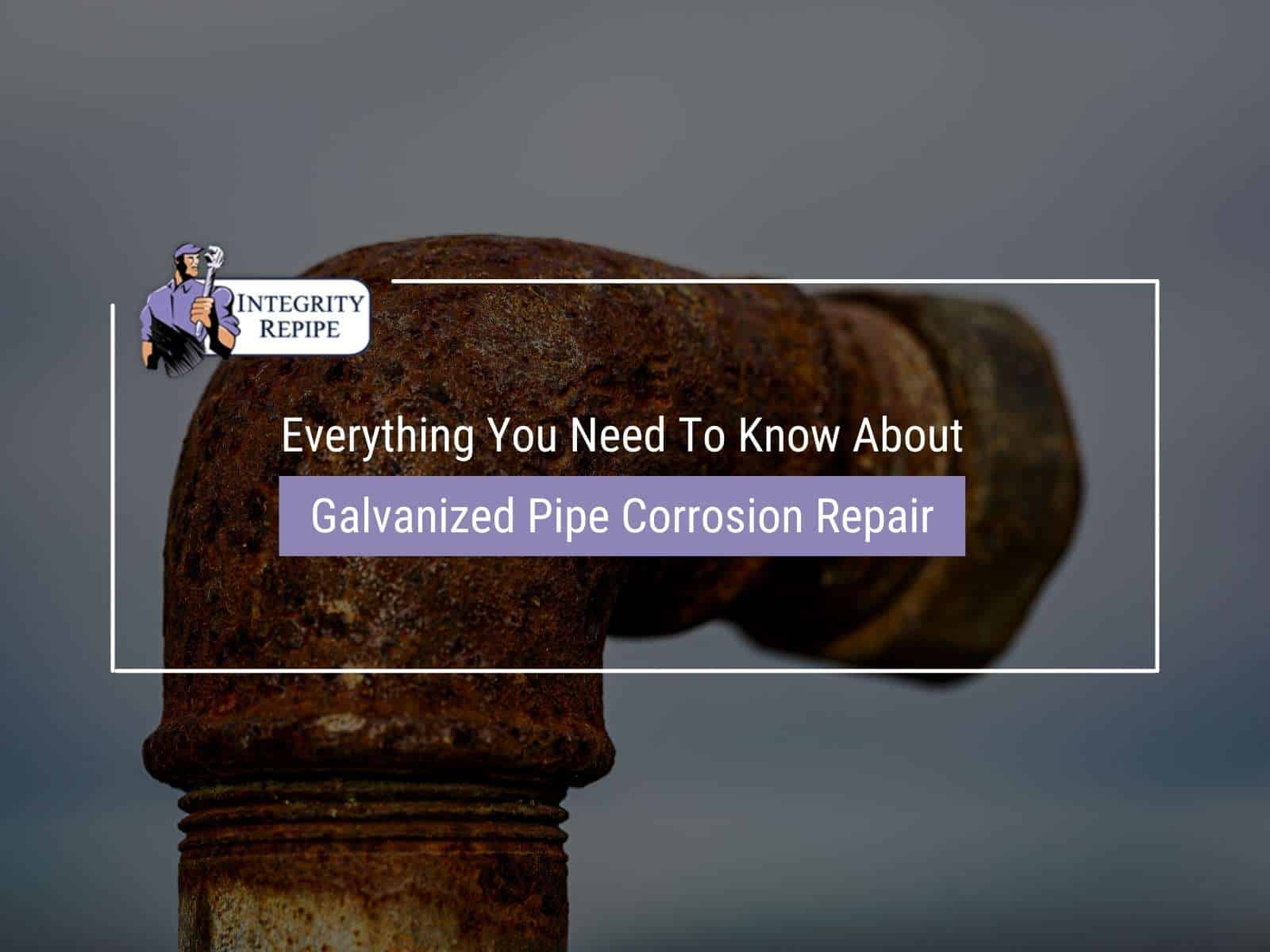
Galvanized was standard here through roughly the 1960s. The zinc coating sacrifices itself first, then the steel underneath rusts, and the rust grows inward rather than outward. A three quarter inch line can end up with the working opening of a pencil. Static pressure at your gauge reads completely normal, because the pipe still holds pressure without any trouble. Volume is what collapses. If you want the mechanism in detail, we’ve written about how galvanized pipe corrodes from the inside separately.
Scale in copper, and why the water here speeds it up
Copper doesn’t rust the same way, but water in this region is hard, and decades of mineral scale building up inside the pipe narrows the bore and roughens the wall. Homes near the water add another variable, because coastal air and salt exposure work on the outside of the pipe while the water works on the inside. Copper from the 1970s through the 1990s around here tends to show pinholes and wall thinning before it shows outright blockage, which is why the first symptom is often a leak rather than a weak shower.
Housing era as a shortcut
You can narrow this down before anyone opens a wall. Pre-1970 tract construction: assume galvanized until proven otherwise. Roughly 1970 through the mid-1990s: almost certainly copper, and the question becomes condition rather than material. Newer than that: copper or early plastics, and weak flow more often traces back to a valve or a regulator than to the pipe.
The jobs we see across Mission Viejo, Laguna Hills, and the older parts of San Clemente cluster around a specific pattern. The homeowner reports the shower getting weaker over two or three years, not overnight. The gauge reads fine. Somebody has usually already replaced a showerhead or two. When the wall opens, the pipe is intact, holding pressure, and visibly narrowed on the inside. Nothing about that house was broken in a way a pressure test could find.
Here’s the position we’ll defend, and it puts us at odds with a fair amount of what’s published on this topic. Once the restriction is the pipe itself, every fix short of replacing the pipe is a way of spending money to delay the same conversation. Descaling treatments and epoxy linings get marketed hard for exactly this situation, and they can buy time in the right house. But they don’t restore the original opening, they don’t address wall thinning in copper that’s already thin, and in a home where the supply degraded uniformly over forty years they tend to move the failure point rather than remove it. We would rather tell somebody their house isn’t ready for a repipe yet than sell them a partial measure that resets the clock by three years.
“People come to us convinced they have a pressure problem because the gauge told them so, and the gauge isn’t lying. It’s answering a different question than the one they’re asking. Pressure tells you how hard the water is being pushed. It says nothing about how much room the water has to move through. In a house where the inside of the pipe has been closing up for forty years, you can have textbook pressure at the hose bib and still not be able to run a shower and a dishwasher at the same time. The only way to see that is to cut the pipe open and look at the opening.”
Joe Ludlow, Master Repiper, Integrity Repipe.
“Re-piping is no joke: 50-60 holes in drywall and stucco, lots of dust everywhere, a number of corroded copper pipes pulled out of the walls to make space for the new PEX. They also found that my water heater needed an expansion tank to be up to code and installed that as well. I’ll be happy to recommend Integrity to my HOA, as our community unfortunately has endemic slab leaks.”
Brian Toy, 5-star Google review, San Clemente
Why A Booster Pump Usually Makes Things Worse
Search this problem and you’ll be offered a booster pump inside of about three results. Pump manufacturers publish a lot of content on low water pressure, and they’re not wrong in every case. For a specific kind of house it’s exactly the right call: you sit at the top of a pressure zone, your static reading is genuinely low, your water district confirms low delivery at the main, and your plumbing is in good condition. In that house a booster does what it says on the box.
That is not most houses with weak showers in Orange County.
If your static reads 60 psi and your flow dies under demand, the restriction is inside your plumbing, and a booster pump doesn’t remove a restriction. It pushes harder against one. You get a modest improvement at the fixture for a while, and you also get elevated sustained pressure running through pipe that already has thin walls, corroded joints, and forty years of deposits. On copper that’s near the end of its service life, that’s the mechanism by which a flow complaint becomes a leak. We see this in second opinions more than we’d like: somebody spent real money on a pump, got six months of marginal improvement, and then called about water coming through a ceiling. The pump wasn’t defective. It was solving a problem the house didn’t have, and the pressure it added found the weakest fitting in the system.
What To Check First, And What Each Answer Costs You
Work down this list in order. Each row costs more than the one above it, which is the whole point of doing them in sequence rather than starting with a guess.
| What you find | Rough expense tier | Who handles it |
|---|---|---|
| Main shutoff or meter valve not fully open | Free | You, or a call to your water district |
| Clogged aerator or showerhead | Under $30 | You |
| Failed pressure regulator | Low hundreds | Licensed plumber |
| Regulator plus the required expansion tank | Several hundred | Licensed plumber, permit may apply |
| Hidden leak | Varies with what it damaged | Leak detection first, then repair |
| Galvanized supply lines throughout | Four to five figures | Whole house repipe |
| Scaled or failing copper throughout | Four to five figures | Whole house repipe |
Those tiers are general. What a job actually runs depends on the size and age of the home, how the plumbing was routed, whether an HOA controls wall access, and what the crew finds once walls are open. Project outcomes vary by site conditions.
Two rows on that table deserve their own reading. If the symptom is a leak rather than weak flow, start with how to find a hidden water leak, and if the water is disappearing under the foundation, slab leak repair is a different job from a repipe. And we’re not going to work through partial repiping against a full repipe here, because that decision has enough moving parts to deserve its own article.
When Repiping Is The Honest Answer
Not every weak shower is a repipe. Most aren’t. The four free checks near the top of this article resolve a real share of the calls that come in, and a worn out regulator accounts for a good number of the rest. We’d rather tell you that than sell you a job you don’t need.
Repiping earns its place when the pipe itself is the restriction. The pattern that points there is consistent: normal static pressure with flow that collapses under demand, galvanized supply confirmed, repeat pinhole leaks in copper, discolored water on the first draw of the morning, or a house old enough that you’re weighing a third spot repair against the pattern the first two revealed.
The reason we push toward whole house rather than section by section in those homes is that the pipe didn’t degrade in one spot. It degraded everywhere at roughly the same rate, and repairing the segment that failed first just tells you where the second one will be. If you’re weighing materials, we’ve laid out copper against PEX-B and why we install what we install, and the mechanics of a PEX repipe if you want to know what a day of it looks like in your house.
If you want a read on your own house, we’ll come out and give you a free in-home estimate. Call 949-397-2404. Integrity Repipe holds CSLB License #C-36-993925, we don’t subcontract our crews, and every repipe we do carries a lifetime transferable warranty. If you’d rather hear it from somebody other than us first, our references from past customers are a reasonable place to start.
Frequently Asked Questions
What is normal water pressure for a house in California?
Most homes run between 45 and 65 psi static, measured with everything inside shut off. The California Plumbing Code caps you at 80 psi and requires a pressure regulator above that. On the low end, Title 22 of the California Code of Regulations obligates your water system to maintain at least 20 psi in the main at your service connection at all times. If your static reading sits below 20, that’s a conversation with your water district rather than a plumbing repair. Anything in the 45 to 65 band with good flow behind it is a healthy system. Anything above 80 is actively damaging your fixtures and pipe.
What is the difference between water pressure and water flow?
Pressure is the force pushing water through the pipe, measured in pounds per square inch. Flow is the volume that arrives at the fixture, measured in gallons per minute. They’re related but independent, and a house can have textbook pressure and poor flow at the same time. That combination almost always means the inside of the pipe has narrowed, because a restriction limits volume without necessarily affecting the static pressure reading. It’s the single most useful distinction on this topic and the one most articles skip entirely.
How do I test my water pressure without calling a plumber?
Buy a screw-on pressure gauge for around twelve dollars, thread it onto the hose bib nearest where your main line enters the house, shut off everything inside, and open the bib fully. That number is your static pressure. Then leave the gauge on and have somebody run a shower and the kitchen sink together, and read it again. The difference between those two numbers is the diagnostic. A few psi of drop is normal. Twenty or more under ordinary demand means something is restricting volume inside your plumbing.
Why is my water pressure only low in one bathroom?
A single-fixture problem is almost never a whole-house problem, which is good news financially. Start with the aerator or showerhead, since mineral buildup collects there first. Check the angle stops under the sink or behind the toilet, because they get bumped closed during cleaning and storage more often than you’d think. If it’s a toilet that refills slowly, the fill valve is a likelier culprit than the supply. Only if the whole branch serving that bathroom is weak does the pipe come into question.
Why did my water pressure drop suddenly instead of gradually?
Onset speed is diagnostic. Gradual decline over months or years points at accumulation: scale, corrosion, a regulator slowly failing. A sudden drop points at an event. Somebody closed a valve, the district did work on the main, a regulator diaphragm let go all at once, or a pipe started leaking somewhere you can’t see. If it happened overnight and nothing in the house changed, call your water district first and ask whether they’ve been working nearby. That call is free and it resolves a fair number of these.
Can a pressure regulator be adjusted, or does it have to be replaced?
Both, depending on why it’s misbehaving. The adjusting screw on top does change the downstream setting, and a regulator that’s simply set wrong can be dialed in with a gauge attached so you can see what you’re doing. But a regulator that’s failed internally, which is the common case once it’s past ten or twelve years, won’t hold whatever you set it to. If adjusting it produces no change, or the pressure drifts back within days, the unit is done. Replacement usually triggers the expansion tank requirement covered above, so budget for both.
Will a booster pump fix low water pressure?
Only if you genuinely have a pressure problem. If your static reading is truly low and your water district confirms low delivery at the main, a booster is a legitimate fix. If your static reads normal and your flow collapses under demand, a booster pushes harder against a restriction it can’t remove, and on aging copper that added pressure tends to find the weakest fitting in the system. Take the gauge readings before you buy anything. The two-reading test in this article costs twelve dollars and tells you which of those two houses you’re living in.
What happens if I ignore low water pressure?
It depends entirely on the cause, which is why diagnosing it matters more than living with it. A clogged aerator will never be more than an annoyance. A slowly failing regulator can drift the other direction and start over-pressurizing your system. Galvanized pipe that’s closing up continues closing up, and the same corrosion narrowing the opening is thinning the wall. Low flow caused by a hidden leak is the one to take seriously, because the water is going somewhere, and finding it early is the difference between a repair and a restoration project.
Does low water pressure mean I have a hidden leak?
Sometimes, and there’s a cheap way to check. Shut off every fixture and appliance in the house, including ice makers and irrigation, then look at your water meter. If the low-flow indicator is still turning, water is moving somewhere it shouldn’t be. Other signs worth taking seriously are a water bill that climbed without explanation, warm spots on a slab floor, the sound of running water with everything off, or a section of landscaping that stays green through a dry stretch. Any of those together with weak pressure moves leak detection to the top of the list.
Do I need a permit to replace a pressure regulator in Orange County?
Permit requirements for water service work are set by the city or county building department with jurisdiction over your address, and they aren’t uniform across the region. Some jurisdictions treat a regulator swap as minor repair, others require a permit and inspection, and a number of local codes attach additional requirements when a regulator goes in on an existing system, including thermal expansion control. A licensed contractor working in your city will know the local practice and should be pulling whatever permit applies. If somebody offers to do the work without one because it’s faster, that’s worth a second thought.
Will repiping my house actually increase my water pressure?
It will restore your flow, which is what most people mean when they ask this. Repiping doesn’t raise the pressure your water district delivers to the meter, so if your static reading is genuinely low at the property line, new pipe won’t change that number. What it does is remove the restriction between the meter and your fixtures. In a house where corroded galvanized or heavily scaled copper has been strangling volume for decades, the difference at the shower is dramatic, and it shows up immediately. That’s the honest version: repiping fixes flow, not supply pressure. A free in-home estimate starts with the same gauge readings described here, so you’ll know which one you have before anybody quotes you a number.
The Short Version
Spend twelve dollars on a gauge and take two readings before you do anything else. If your static pressure is normal and your flow collapses when a second fixture opens, you have a restriction, not a pressure problem, and no pump or valve adjustment is going to fix it. If your static is high, look at the regulator. If it’s genuinely low, call your water district before you call a plumber. And if the pipe turns out to be the restriction, the age of the house will usually tell you that before anyone opens a wall.
Questions about your own house? Call Integrity Repipe at 949-397-2404 or request a free in-home estimate. We serve Orange County, Los Angeles County, and San Diego County from our San Clemente office.

Published by – Integrity Repipe, Inc
Email: [email protected]
Website: www.integrityrepipe.com
Mission Viejo, CA
27281 Las Ramblas, Suite 200
Mission Viejo, CA 92691
Phone: 877-473-7473
San Clemente, CA
927 Calle Negocio Suite O
San Clemente, CA 92673
Phone: 949-397-2404
Long Beach, CA
2201 N Lakewood Blvd, Ste D #297
Long Beach, CA 90815
Phone: 562-362-5040
Chula Vista, CA
591 Telegraph Canyon Road
Chula Vista, CA 91910
Phone: 619-313-5744
Ladera Ranch, CA
27762 Antonio Parkway L1
Ladera Ranch, CA 92694
Phone: 949-397-2795
Lakeside, CA
8337 Winter Gardens Boulevard
Lakeside, CA 92040
Phone: 619-494-3507
Aliso Viejo, CA
27068 La Paz Rd #771
Aliso Viejo, CA 92656
Phone: 949-449-1142
Oceanside, CA
1759 Oceanside Blvd C,
Oceanside, CA 92054
Phone: 442-300-3057
Porter Ranch, CA
19360 Rinaldi
Porter Ranch, CA 91326
Phone: 818-630-9265